Every year, Europe generates millions of tons of food waste, much of which ends up being underutilized. RUBBIO was created precisely to change this reality, driving a new generation of sustainable solutions capable of transforming this waste into high-value-added industrial materials.
Funded by the Circular Bio-based Europe Joint Undertaking (CBE JU) under Grant Agreement No. 101290652, RUBBIO is a European project coordinated by Aitiip Centro Tecnológico that champions innovation in bio-manufacturing to develop more sustainable alternatives to traditional fossil-based materials.
The project will work on the valorization of starch-rich food waste—such as bread and potato scraps—by integrating advanced biotechnology and chemical engineering. Through these technologies, RUBBIO will develop new production pathways capable of converting these by-products into high-performance rubber polymers intended for demanding industrial applications.
The solutions developed will be mainly oriented toward sectors such as technical flooring and footwear, where there is a growing need to incorporate more sustainable materials without compromising key properties like strength, durability, or technical performance.
A new vision for industrial waste
RUBBIO is based on a clear idea: waste should not be seen as a problem, but as an opportunity to generate new raw materials within a more circular and efficient economy.
To achieve this, the project will develop three circular value chains within the European territory, connecting all stakeholders involved in the process: from waste management and transformation to the manufacturing and final validation of the new materials.
This approach will enable progress toward more sustainable and resilient production models, aligned with European objectives for decarbonization and reducing dependence on fossil resources. In addition to the environmental component, RUBBIO seeks to generate real industrial impact, demonstrating the technical viability and scalability potential of these new bio-based solutions for their future market implementation.
Official launch of the project
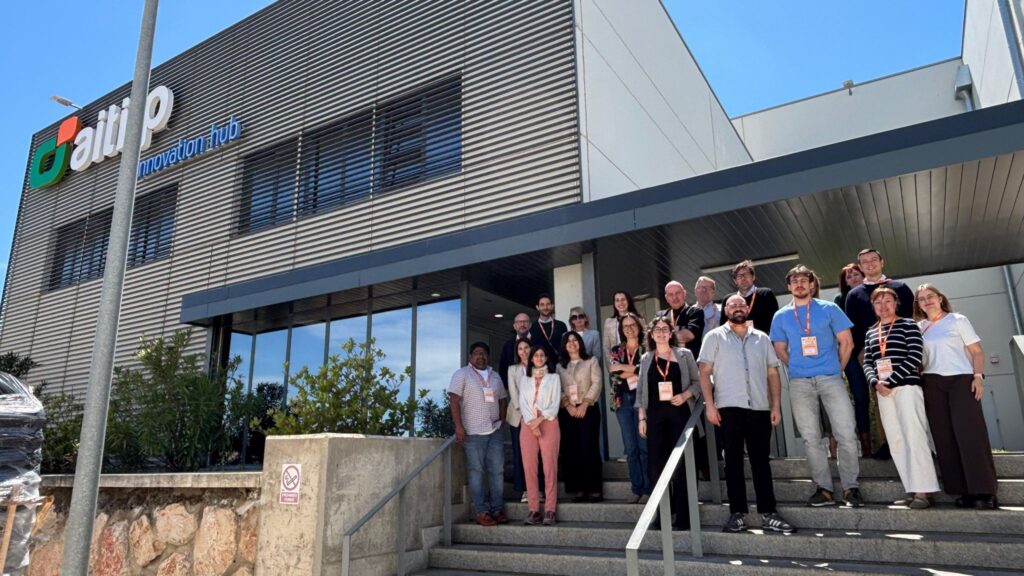
The project held its kick-off meeting at Aitiip’s facilities in Zaragoza, marking the official start of the consortium’s technical and coordination activities.
During this first meeting, the partners defined the project’s strategic lines, work planning, and the collaboration bases that will guide the development of RUBBIO over the coming years.
«RUBBIO will allow us to advance in new solutions capable of transforming food waste into high-performance materials, combining sustainability, innovation, and real industrial application.»
— Violeta Calvo Sein-Echaluce, Project Coordinator at Aitiip
A European ecosystem to boost the circular bioeconomy
RUBBIO brings together 12 entities from six European countries—Spain, the United Kingdom, Ireland, Belgium, Poland, and Italy—that provide complementary capabilities in research, technological development, industrial validation, and innovation transfer.
Alongside Aitiip Centro Tecnológico, participants include entities specialized in renewable energy and resource valorization such as C-source Renewables; internationally renowned universities like Cranfield University, The University of Edinburgh, and Katholieke Universiteit Leuven; as well as organizations with extensive experience in biomass characterization and biotechnological processes like Celignis.
The project also incorporates industrial and market application insight through companies and technology centres like Tecnopackaging, Artigo, Novex, and Fundación Tekniker, while entities such as Sieć Badawcza Łukasiewicz and Centrum Transferu Technologii – Innovations will reinforce applied research, innovation, and technology transfer activities.
The combination of scientific, technological, and industrial capabilities will accelerate the development of sustainable solutions with real application potential, bringing research closer to the current needs of the European industry and contributing to the advancement of the circular bioeconomy in Europe.